Therapy for queer and trans adults.
Including folks in open relationships, kink-identified people, and anyone navigating gender, identity, or the parts of yourself you haven't said out loud yet.
I'm Jared Gorfinkel, PsyD (he/they), a licensed Oregon psychologist offering telehealth sessions statewide. Psychodynamic. Relational. Sliding scale $80–$200, with pro bono slots when I can hold them.
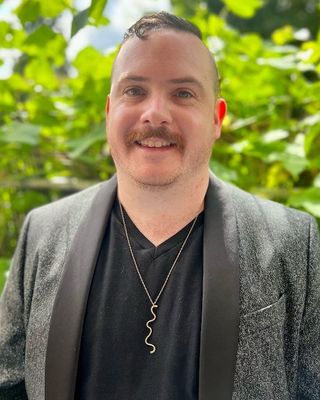
Jared Gorfinkel, PsyD · he/they
About Jared
Trained across five clinical settings. Grounded in relational practice.
- CredentialsPsyD, Clinical Psychology (Wright Institute, Berkeley, 2020)
- LicensureLicensed Psychologist, State of Oregon, #3476
- PronounsHe/They
- FormatIndividual teletherapy, statewide Oregon
- ClientsAdults 18+
- FeesSliding scale $80–$200 · Pro bono slots $0–$50 when held
- InsuranceOut-of-network. Good Faith Estimate provided per No Surprises Act.
- LanguagesEnglish
Perhaps you were raised somewhere that values mental health and supports therapy. More often, you were taught that asking for help was "weak" or "shameful," or that the right kind of help didn't exist for the shape of your life.
My training was generalist by design: I've worked in a middle-school system, a university counseling center, several community mental health agencies, a methadone maintenance clinic, and a large group practice. That spread matters. It means the room I build with you can hold both the ordinary textures of life and the kinds of difficulty that don't fit neatly on an intake form.
I do my strongest work with gender and sexual minority folks navigating life's stressors: anxiety, depression, trauma, grief, and the relational patterns we keep returning to. My approach prioritizes a psychodynamic and relational frame, while drawing from mindfulness and cognitive approaches to give you tools along the often abstract, meandering path that is the work.
I work to minimize the power differential between us. Honest self-disclosure when that helps you; disciplined neutrality when that helps you more. We stay oriented to what's actually happening in the room.
Who I work with
If the room you need doesn't exist yet, I can probably help you build it.
Queer & trans adults
Including folks who are questioning, newly out, long out, or somewhere stranger. Gender exploration welcome and not pathologized.
Non-monogamous partnerships
Open relationships, polyamory, relationship anarchy, solo-poly. I won't treat your structure as the problem.
Kink-identified clients
BDSM, leather, fetish, power exchange. Kink-allied clinical frame: experience, not exoticization.
Identity work
When the self you were given stops fitting. Masculinity, femininity, gender, family script, the whole inheritance.
Trauma & grief
Including trauma that wasn't named as such: the chronic kind, the systemic kind, the loss that didn't get a ritual.
Anxiety & depression
Often the surface that brings people in. Usually the beginning of a longer conversation about patterns, meaning, and relationship.
Sex-worker allied
Without shame, without rescue narratives. I work with your life as it actually is.
Racial-justice allied
I do my own work on whiteness. I won't make you explain racism to me in your therapy hour.
Approach
Psychodynamic at the bones. Practical at the edges.
My primary frame is relational and psychodynamic. The idea is that the patterns you lived through early (and the relationships that shaped them) are quietly organizing the present. Therapy becomes a place to notice those patterns with another person, in real time, with enough safety to try something different.
The work is less about fixing what's broken and more about learning what you've been carrying, why you've been carrying it, and what gets to change now that you know.
I also draw from mindfulness, ACT, DBT, and third-wave cognitive approaches. Especially when a client needs concrete tools for distress tolerance, emotion regulation, or the embodied practice of noticing. I'm queer- and trans-affirming, kink-allied, sex-positive, and informed by feminist and multicultural frames.
I try to stay honest about what therapy can and can't do. I'll hold you accountable when that's useful. I'll also know when to get out of your way.
Research & writing
What shaped my practice.
Doctoral Dissertation · Wright Institute, 2020
"Dresses and Cowboy Hats: The Impact of Masculinity Ideology on Self-Identified Femmes and Their Sense of Self"
My doctoral work examined how dominant masculinity ideology (the cultural script for what men should be) shapes femmes' interior experience. That includes femmes who are trans, queer, non-binary, or outside cisheteronormative scripts altogether. The research is part of why I take the language and texture of gender so seriously in the room. If you've ever felt that who you are doesn't fit the categories you were handed, this is a conversation I've already been having for years.
Gorfinkel, J. (2020). Doctoral dissertation, The Wright Institute, Berkeley, CA.
Fees & access
Transparent sliding scale. No insurance required.
Sliding scale
Choose the rate that honestly reflects your income and resources. No means-testing, no documentation required. Trust is the contract.
Pro bono & hardship
A small number of reduced-fee slots reserved for folks in acute financial hardship. Ask during consultation. If I can hold one, it's yours.
Consultation
A low-stakes chance to see if I'm a fit before you book anything. I'd rather refer you well than start a bad match.
FAQ
What a lot of people ask before booking.
What happens on the free consultation?
A 15–30 minute video call. I'll ask a little about what's bringing you in. You'll get to hear me talk and see whether I feel like someone you could be in a room with week after week. You can ask me anything, including the hard questions about my experience with your particular community or concern. There's no intake paperwork, no charge, and no obligation to book after.
Do you work with folks outside Portland?
Yes. My license is Oregon-statewide and my practice is fully teletherapy, so I can see you whether you're in Portland, Eugene, Bend, Medford, the Gorge, coastal Oregon, or anywhere else in the state. You do need to be physically located in Oregon during sessions.
Are you actually kink-allied, or is that a sticker?
It's not a sticker. I've done training and ongoing consultation in kink-affirmative practice. I treat kink as a lifestyle and identity, not a symptom. I won't mistake your dynamic for dysfunction, and I won't need you to educate me on basic vocabulary. If there's a specific community concern (D/s dynamics, negotiation, aftercare, subspace/drop, community ethics) that you want to bring in, we can.
I'm not sure what I'm dealing with. Is that a problem?
No. Most people who start therapy can name a feeling ("something's off") before they can name a problem. Part of the work is finding language for what's actually going on. You don't need a diagnosis, a goal, or a clear narrative to start.
How often do we meet? How long does therapy take?
Most of my work is weekly 50-minute sessions. Some clients move to every other week after some stability lands. The length of therapy varies: some people come for a specific concern and finish in a few months; others do longer-term work where the point is the sustained relationship itself. We'll check in on what seems right for you.
What if I'm in crisis right now?
If you're in crisis, don't wait for a consultation. Call or text 988 (the Suicide & Crisis Lifeline), text HOME to 741741 (Crisis Text Line), or go to your nearest emergency room. The Trans Lifeline is (877) 565-8860. I'm not set up for emergency care.
Book a consultation
Don't be alone with suffering.
The fastest way to start is a free 15-minute video call. I'll send a link, we'll talk for a bit, and you can decide from there. No intake paperwork before the call.
-
Phone(503) 213-9160 · Voicemail confidential
-
Emailhello@jaredgpsyd.com
-
Based inPortland, Oregon · Telehealth statewide
-
Existing clientsClient Portal →
If you're in crisis
This page (and my practice) is not set up for emergencies. If you're in crisis, call or text 988 (Suicide & Crisis Lifeline), text HOME to 741741 (Crisis Text Line), or call Trans Lifeline at (877) 565-8860. If life is in immediate danger, call 911 or go to your nearest emergency room.